Controls the case, invitations, helper review, reports, and contributor viewing.
Privacy in plain language
How TAYLOR protects a file.
The original stays in private encrypted storage. A one-way SHA-256 fingerprint helps show whether those exact bytes changed later.
Private file
Encrypted and access-controlled
The whole workspace
From a private case to a useful report.
TAYLOR keeps the survivor or case owner in control while trusted people contribute specific kinds of help.
- 01Create a private case
Use a codename and a brief factual summary. A temporary workspace can be started without an account and claimed before it expires.
- 02Preserve and organize
Add original files, public-source URLs, dates, factual notes, and returned court or agency records.
- 03Invite someone you trust
A unique contribution link lets a friend upload evidence. Case viewing remains off unless the owner explicitly enables it.
- 04Ask an approved helper
The owner may submit the case for review. One assigned
taylor_helpercan collaborate inside the private workspace. - 05Share a controlled report
The owner can create a temporary report link containing the case timeline, source notes, fingerprints, and file thumbnails.
Access follows a role
Not everyone sees the same thing.
Access is based on the signed-in account, case assignment, owner choices, and whether a private link is still active.
Uploads through a unique link. They see the case only when the owner separately allows it.
Works only on a case assigned to their approved taylor_helper account.
An owner or assigned helper sees the anchor button only when also in taylor_wallet.
Feature permissions
TAYLOR groups unlock different tools.
An account can belong to more than one group. These permissions add features, but they do not automatically reveal a private case.
Case review and collaboration
Can review consented case submissions, work on assigned cases, collaborate with helpers, and review community submissions.
Does not make someone law enforcement, an attorney, or an emergency responder.Restricted PublicData.com search
Unlocks the limited name-search test. Each provider request is counted and audited without storing the searched name or returned records.
Requires a lawful case-related purpose. Results may be inaccurate and must be verified.Supporting member features
Unlocks the Member tools page and member recognition features, including guided public Instagram search.
Membership does not grant helper status or access to anyone’s case.BSV wallet and evidence anchors
Shows the wallet page, balance, and receive address. An eligible case owner or assigned helper can anchor an evidence fingerprint.
The file and case details remain private and off-chain.Internal utility tokens
Shows configured token balances and eligible token actions inside the wallet page.
These database records are not BSV, money, investments, or case-access rights.Groups combine; case consent stays separate.For example,
taylor_helper + taylor_publicdata permits helper work and the restricted search, but the helper still sees only a case that was submitted and assigned to them.The upload journey
One file. Four careful steps.
- 01You choose a file
Keep the original image, video, or document whenever possible.
- 02TAYLOR fingerprints it
SHA-256 turns the file’s exact bytes into a 64-character fingerprint.
- 03TAYLOR encrypts it
The stored copy is scrambled with a secret server-side key.
- 04Authorized access only
The file is kept outside the public web directory and delivered only after an access check.
Inside a case
Different material stays connected.
Encrypted screenshots, photos, videos, and documents with dates, labels, notes, and SHA-256 fingerprints.
URLs and observations from lawfully accessible public pages. The source is logged without bypassing privacy controls.
Plan FOIA, court, police, dispatch, and other requests; track their status; then attach encrypted responses by record type.
Owners and assigned helpers keep factual collaboration notes alongside the preserved material.
SHA-256 made simple
A fingerprint for the file—not its contents.
SHA-256 reads the file and produces a fixed-length value. It is designed as a one-way calculation: the fingerprint does not reveal the photo, video, or document.
Even a tiny change produces a very different result. Later, TAYLOR can calculate the fingerprint again and compare it with the saved value.
3a7bd3e2360a…f2f291c0e7a1423b…8d41What a match means: the compared files contain the same bytes. It does not prove who created the file, whether the content is true, or what happened outside the file.
Not a public media folder
Why a stranger cannot browse to your upload.
- The encrypted file is stored outside the public web directory.
- A download request must pass TAYLOR’s case-access rules.
- The application decrypts the file only for an authorized download.
- Private downloads use no-store instructions so browsers and intermediaries are told not to cache them.
Who may be authorized?
The case owner, the helper assigned to an actively shared case, and—only if the owner allows it—a trusted contributor. A private report link can also expose selected case material to anyone holding that link until it expires or is revoked.
Privacy-preserving proof
Encrypted evidence is not blockchain data.
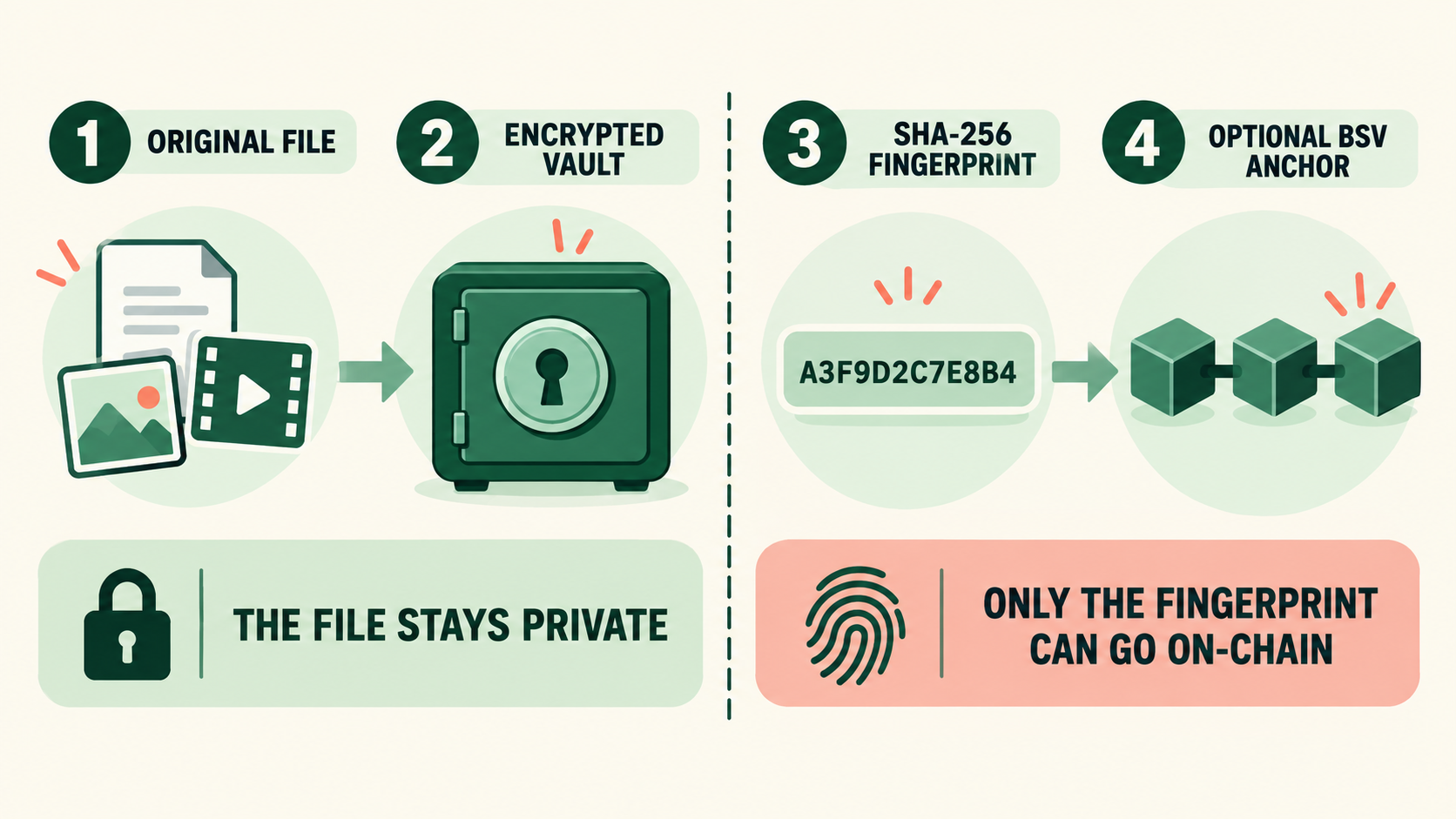
TAYLOR encrypts the original file in the private evidence vault and calculates a SHA-256 fingerprint—a fixed-length value that changes if the file changes.
An optional BSV anchor can publish that fingerprint as a timestamped integrity reference. The image, video, document, case details, and encryption key must remain off-chain.
Encrypted vaultProtects the private file at rest.
SHA-256 fingerprintHelps detect whether the original file changed.
Optional BSV anchorRecords only the TAYLOR|<SHA-256> tag and fingerprint when anchoring is enabled.View a real TAYLOR transaction ↗
Optional blockchain proof
The fingerprint may go on-chain. The file does not.
An eligible case owner or assigned helper can choose to create a BSV transaction that anchors the SHA-256 fingerprint as a timestamped integrity reference. The user must also belong to taylor_wallet. The evidence file, case details, names, notes, and encryption key stay off-chain.
Encrypted fileStays private
TAYLOR tag + fingerprint
TAYLOR|<SHA-256>Optional BSV anchorNo evidence content
Beyond one case
Research and learning can improve together.
TAYLOR also maintains reviewed resources that support careful casework without publishing private case information.
Visitors can suggest educational material, services, shelters, and local alert programs. Approved helpers review submissions before publication.
The directory gathers public-source research tools. Visitors can suggest a tool or flag a broken or unsafe link for review.
Approved helpers can claim cases, message an assigned helper, and collaborate without making a case public.
Signed-in contributors can receive internal CARE recognition for eligible community activity. CARE is not money or case access.
Important limits
Privacy still depends on safe choices.
Browser history, downloads, email previews, cloud backups, and shared-device access can reveal activity.
A contribution or report link should be treated like a password. Revoke it when it is no longer needed.
Use case codenames and check files for addresses, children’s information, medical details, or safety plans.
It protects stored files, but an authorized person can still download or share them. Server and account security remain important.
Ready when you are